Posted by Matt Dempsey matthew_dempsey@epw.senate.gov (4:30pm ET)
Link to Senator Inhofe’s Opening Statement (Audio)
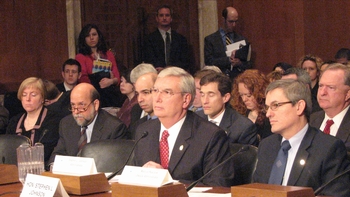
Senator Inhofe, Ranking Member of the Senate Environment and Public Works Committee, discussed several Oklahoma priorities with the Administrator of the Environmental Protection Agency (EPA), Stephen Johnson, during today’s Environment and Public Works Committee hearing entitled, “Hearing on the President’s Proposed EPA Budget for FY 2009.” At the hearing, Senator Inhofe thanked Administrator Johnson for EPA’s continued progress at Tar Creek and took the opportunity to raise several Oklahoma-specific concerns.
SENATOR INHOFE PRAISES EPA FOR PROGRESS ON TAR CREEK:
“As you are well aware, solutions to the Tar Creek Superfund Site have long been on my list of top priorities. Last week, EPA announced a new plan addressing not only clean-up, but also acting upon a provision I placed in the Water Resource Development Act 2007 (WRDA) to provide voluntary relocation assistance to area residents. I appreciate the work of key EPA officials Susan Bodine, Richard Greene, and Sam Coleman, along with many others working on this site. I look forward to continuing to work with you to implement this new plan and thank you for all your help to date on this important issue.”
Background
Last week, the Environmental Protection Agency released its selected remedy addressing key components of the Tar Creek Superfund Site. The EPA’s remedy includes both the completion of voluntary relocation assistance for the area residents and continued chat sales. In the Water Resources Development Act of 2007, Senator Inhofe included a provision directing the EPA to reconsider including resident relocation in its upcoming remediation plan, and provided them the legal authority required to include voluntary relocation in the plan. The EPA has acted upon Senator Inhofe’s legislation and has now included relocation in its selected remedy.
Read More: INHOFE ANNOUNCES REMEDIATION PLAN FOR TAR CREEK; Oklahoma Reality VS Washington DC Rhetoric
Editorials: Oklahoman Editorial: Tar Creek Triumph; Tulsa World Editorial: Enter Jim Inhofe
Articles: Tulsa World: Inhofe: EPA To Fund Buyout; Buyout May Be Done In Two Years; Agency Unveils Plans For Tar Creek; Tar Creek: Buyout Is Applauded By Henry
SENATOR INHOFE RAISES CONCERNS IMPORTANT TO NATURAL GAS PRODUCTION
“As you are aware, the oil and natural gas industry is extremely significant in Oklahoma. Oklahoma ranks second in the nation in natural gas production with over 120,000 wells in operation. Recently, EPA asked for comments on an ‘Information Collection Request (ICR)’ regarding the activities of coal bed methane (CBM) operators to re-evaluate Clean Water Act guidelines. The survey published in the Federal Register requests detailed information regarding company ownership, costs, earnings, liabilities, and expenses. This business information is extremely sensitive. Further, the Federal Register notice claims that the entire ICR will require on average 163 hours to complete. Will EPA commit to work with the regulated community to narrow this request to the most relevant information?”
Background
The U.S. Environmental Protection Agency (EPA) is moving forward with its study to determine whether to change the regulation of water discharges from coal bed methane (CBM) wells under EPA’s Clean Water Act (CWA) effluent limitation guidelines. To gain a better understanding of CBM operations, EPA has developed a 72-page draft survey that includes detailed technical, economic and financial questions of natural gas operators. EPA is requesting comments on the survey by March 25, 2008. The draft survey is going to be very onerous on natural gas producers of all sizes. It’s not really clear what the true “need” is for this massive information collection. In August, EPA plans to distribute the final mandatory survey to CBM operators to complete and return to EPA.
SENATOR INHOFE RAISES CONCERNS ABOUT EPA IMPLEMENTATION OF BIO-FUELS MANDATE:
“I am deeply interested in the EPA’s implementation of the overly aggressive bio-fuels increase mandated by the Energy Independence and Security Act of 2007 passed in December. These mandates allow no room for error in a fuels industry already constrained by tight supplies, full capacity, environmental regulation, and volatile market conditions. As you know, Congress imposed a nearly five-fold expansion of the Renewable Fuels Standard mandate despite mounting questions surrounding ethanol’s effect on livestock feed prices, its economic sustainability, its transportation and infrastructure needs, its water usage and numerous other issues. On that note, I look forward to working with you to determine if these new mandates are even achievable and to explore the many potential ramifications.”
Background
Earlier this month, Senator Inhofe introduced legislation to provide technical corrections to the Clean Air Act’s Renewable Fuels Standard (RFS) as mandated by the Energy Independence and Security Act of 2007. Senator Inhofe’s bill recognizes the delicate political balance surrounding the RFS and provides simple fixes that are intended to provide flexibility for the fuels industry in meeting these mandates.
Read More: INHOFE INTRODUCES TECHNICAL CORRECTIONS TO THE CLEAN AIR ACT’S RENEWABLE FUELS STANDARD
SENATOR INHOFE DISCUSSES CLEAN WATER STATE REVOLVING FUND PROGRAM:
“As I have indicated, I will once again be supporting efforts to restore the large cut you proposed to the critical Clean Water SRF program. There is a nationwide crisis and a need for more water infrastructure money that is acknowledged by this Administration. In the recent Clean Watershed Needs Survey, you calculated over $200 billion in need for publicly owned treatment works. While I continue to disagree with your cuts to the SRF, I am pleased to see that the Administration has again proposed lifting the cap on private activity bonds for water and wastewater infrastructure projects. I look forward to working with the Administration to see if using the tax code through private activity bonds would help fill some of the infrastructure gap, given the shortage of appropriated dollars. While public-private partnerships are not the sole solution, we need to do everything we can to encourage them since we will never be able to fully fund our infrastructure needs. A good start towards meeting those goals is through compliance assistance. This year, the President’s budget requests the highest level of funding ever for the enforcement program, including its Compliance Assistance Centers to help people comply with the Spill Prevention Control and Countermeasure Program (SPCC) and Disinfection Byproduct rules. I appreciate the Administration’s work to assist the regulated community to comply with often confusing and burdensome rules. This year, the EPA has helped 1,228,000 entities with compliance assistance. EPA’s web-based compliance centers have reached millions more. I applaud EPA for continuing build on these kinds of successes.”
SENATOR INHOFE DISCUSSES COSTLY MANDATES ON LOCAL OKLAHOMA COMMUNITIES:
“Compounding this lack of water infrastructure funding are the many costly new regulations imposed on localities. In Oklahoma, we continue to have municipalities struggling with the arsenic rule and with the Disinfection Byproducts (DBP) Stage I rule. Small systems who purchase water from alternative systems and have not had to test, treat, or monitor their water must now comply with DBPII. In EPA’s most recent drinking water needs survey, Oklahoma identified $4.8 billion in infrastructure needs over the next 20 years. $107 million of that need is to meet federal drinking water standards. This does not include costs imposed by Oklahoma communities to meet federal clean water requirements, the new Groundwater rule, the Disinfection Byproducts Stage II rule or the Long Term 2 Enhanced Surface Water Treatment Rule. As you know, I have been in communication with your office about these rules and their impact on Oklahoma. I am looking forward to continuing to work with you to devise ways to assist these communities in reaching these drinking water standards.”
Background
In December 2007, Senator Inhofe introduced the Small System Drinking Water Act of 2007, a bipartisan bill to assist water systems in Oklahoma and throughout the country in complying with Federal drinking water standards, and require the Environmental Protection Agency (EPA) to utilize all of its resources provided by the 1996 Safe Drinking Water Act amendments (SDWA).
SENATOR INHOFE RAISES CONCERNS ABOUT EPA’S ASSUMPTIONS REGARDING OZONE NAAQS STANDARD:
“Mr. Administrator, in your underlying analysis in issuing a proposed revision to the ozone NAAQS standard, EPA zero-ed out emissions from Canada and Mexico in determining background levels under the rationale that Congress can reduce those emissions by treaty. How do you justify assuming what actions Congress should or will take in setting regulations? And by making that zero-out assumption, don’t you unfairly penalize U.S. border counties if these emissions from Canada and Mexico are not eliminated?”
Background
Senator Inhofe has consistently fought to ensure sound science is applied when addressing clean air regulations in Oklahoma. In a hearing last year, Senator Inhofe asked Administrator Johnson, “Oklahoma, like many States, has made tremendous progress in cleaning up its air. Not a single county in Oklahoma is in violation of the ozone standards. Not a single one, Mr. Administrator. Yet your proposal will put virtually the entire State into non-attainment. How is it that EPA last year considered States like Oklahoma to have clean air that was healthy to breathe, yet next year it will consider the air unhealthy – even as their pollution levels continue to plummet?”
Read More: Inhofe Statement from EPW Committee Hearing on EPA’s Proposed Revision to the Ozone NAAQS; WARNING, STATE THREAT: INHOFE RIPS EPA OZONE PROPOSAL (Jim Myers, Tulsa World, July 12, 2007)
###