Senate EPW Committee History
In 1838, the Senate Committee on Public Buildings was created to replace the Joint Committee on Public Buildings, which had been established in 1837. The Committee was created to oversee the development of federal buildings in the young, but rapidly growing, Federal City of Washington, D.C. In 1857, the Committee on Public Buildings was renamed the Committee on Public Buildings and Grounds and was given responsibility for public buildings and occupied or improved grounds of the United States. In 1947, as part of a reorganization of Senate committees, the panel was renamed the Committee on Public Works. Following another major organizational revision in 1977, its name was changed to the Committee on Environment and Public Works.
Over the years, the Committee’s public works jurisdiction grew from oversight of new federal building construction, additions to the U.S. Capitol and its grounds, and the White House and its grounds to legislative responsibility for the development of the nation’s Interstate Highway System, as well as flood control and navigation projects.
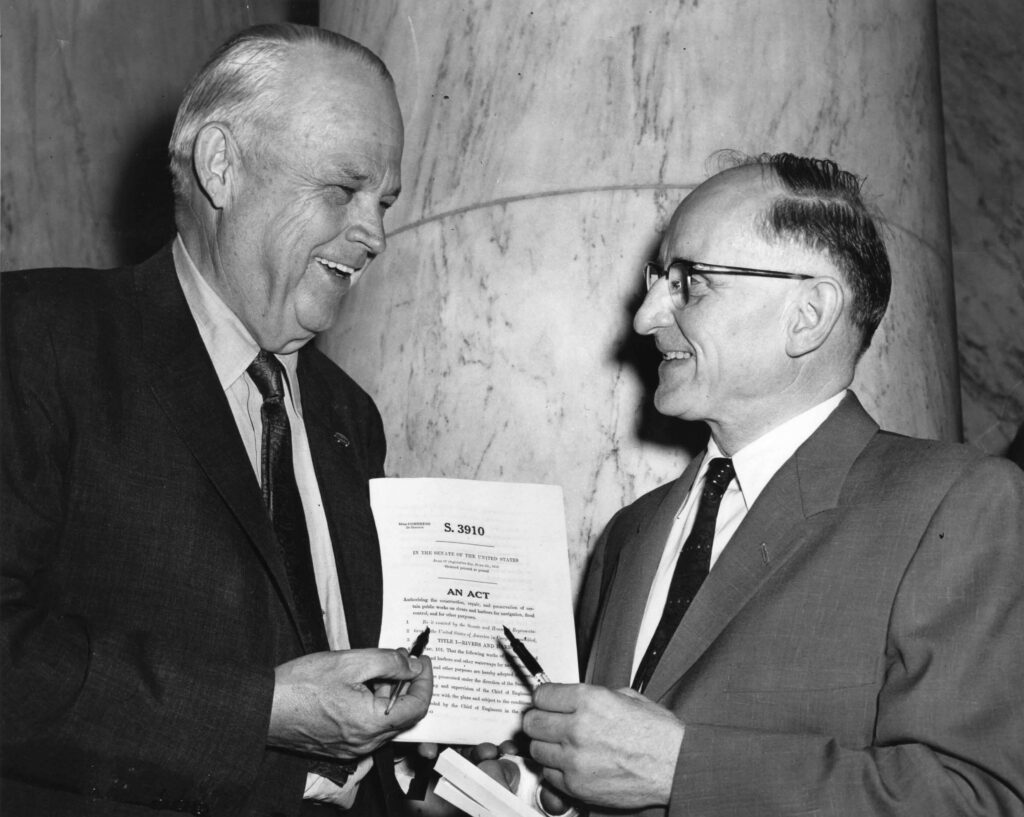
Senator Robert S. Kerr (Democrat from Oklahoma) and Senator Francis Case (Republican from South Dakota) both members of the Senate Committee on Public Works, stand together for the passage of S.3910 - An Act authorizing the construction, repair, and preservation of certain public works on rivers and harbors for navigation, flood control, and for other purposes, 1958. United States Senate Historical Office.
In 1963, the Committee was given responsibility for creating new laws to address air and water pollution, rural and community economic development, and relief from natural disasters. The passage of the Clean Air Act in 1970 and the Federal Water Pollution Control Act in 1972 brought the Committee recognition as the Senate’s forum for environmental protection. In 1977, the Committee’s jurisdiction expanded further to include endangered species, fish and wildlife refuge systems and programs, and the regulation of nonmilitary nuclear power.
The Committee’s oversight also expanded to programs across five cabinet level departments and seven independent agencies, including the Department of the Interior’s Fish and Wildlife Service, the Department of Transportation’s Federal Highway Administration and Coast Guard, the Department of Commerce’s Economic Development Administration and National Oceanic and Atmospheric Administration, the Department of Agriculture’s Natural Resources Conservation Service, the Environmental Protection Agency, the General Services Administration’s Public Buildings Service, the Council on Environmental Quality, the civil works program of the U.S. Army Corps of Engineers, the Tennessee Valley Authority, the Appalachian Regional Commission, the Nuclear Regulatory Commission, the Federal Emergency Management Agency, the Mississippi River Commission, and the nonperforming functions of the John F. Kennedy Center for the Performing Arts.
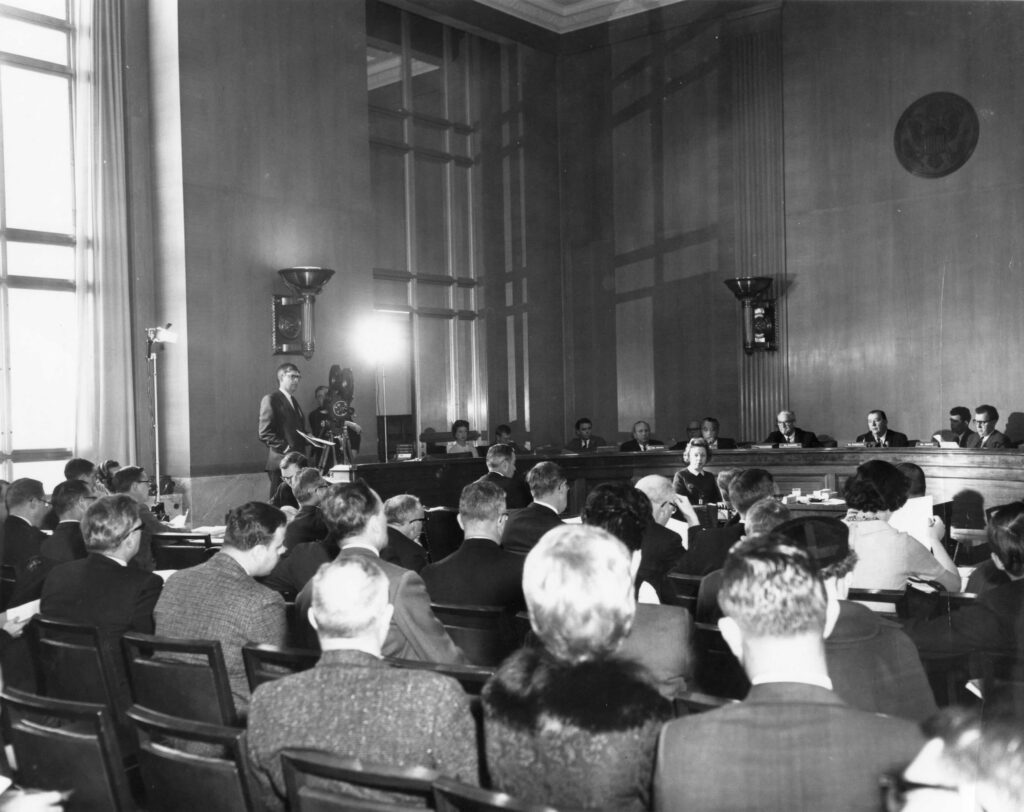
Chairman Jennings Randolph (Democrat from West Virginia) leads a committee hearing. Democratic member, Edmund S. Muskie (Maine) sits to his left. Republican committee members John Sherman Cooper (Kentucky), Hiram L. Fong (Hawaii), and J. Caleb Boggs (Delaware) sit to his right, likely 1967-68. United States Senate Historical Office.