DEMOCRATS NEED TO ANSWER TOUGH QUESTIONS: IF NOT YUCCA, THEN WHERE?
Political Opponents of Yucca Now Willing To Toss 30 Years of Scientific Review Out To Score Political Points
Democratic Senator Hillary Clinton said its “time to move on from Yucca Mountain” at Wednesday’s Environment and Public Works Committee hearing, and has previously stated that, “As president, I will not go forward with Yucca Mountain. My administration will not proceed with Yucca Mountain.” And as Senator Craig pointed out, that means returning nuclear waste back to New York and storing waste onsite indefinitely in 39 states. It also means delaying the clean-up of defense nuclear facilities. Clearly, the United States needs a permanent resting place for nuclear waste. Therefore, the question remains, if not Yucca, then where? That’s the big question left unanswered by EPW Committee Democrats at this week’s hearing.
FACT: Before the Congress directed the DOE to focus its efforts on the Yucca Mountain site in 1986, over 37 states had been considered as potential hosts for a repository beginning with Lyons, Kansas, in the 1960’s. The map below highlights all of those states that have been considered to have geologic formations worth evaluating for repository development.
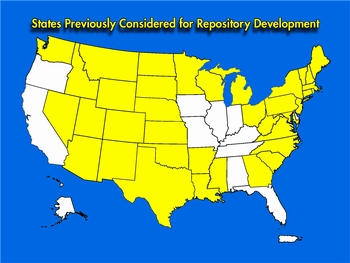
By the end of 1986, DOE had conducted over 5 years of extensive scientific study and spent over $1.1 billion studying multiple sites, with a multi-attribute analysis indicating Yucca Mountain as the best site of the nine that were studied. Confidence in Yucca Mountain and escalating costs led the Congress to direct DOE to focus solely on Yucca Mountain.Since 1986, DOE has spent over $6 billion, engaging more than 2500 scientists from the five National Laboratories, the U.S. Geologic Survey, and dozens of U.S. universities. All this study and analysis was subjected to exhaustive peer review, including the U.S. Nuclear Waste Technical Review Board and the International Atomic Energy Agency (IAEA).No later than June of 2008, DOE will submit an application to the NRC for authorization to build a repository at Yucca Mountain.
This application is the culmination of 25 years of research costing over $6 billion. The NRC has developed detailed regulations to guide the very public process of intensively and accurately assessing whether Yucca Mountain can be safely developed as a repository. NRC technical staff and independent experts will scrutinize the application, and then panels of judges will adjudicate contentions.
Essentially, every element of the application will be put on trial twice with the public and stakeholders able to review and dispute everything except security-sensitive information. How can the Federal government throw away $6 billion dollars without even bothering to find out if Yucca Mountain can withstand the level of scrutiny required by the NRC? Especially when starting over means searching the country for a new site?