IN CASE YOU MISSED IT…Ethanol’s Bitter Taste (Kimberley Strassel, Wall Street Journal, May 18, 2007)
It was a scant two years ago that Georgia’s Saxby Chambliss voted with 73 other giddy senators for an energy bill that required the nation to use 7.5 billion gallons of ethanol. Georgia’s farmers loved corn-based ethanol; Georgia’s agri-businesses loved corn-based ethanol; and all that meant that then-Agriculture Committee Chairman Chambliss loved corn-based ethanol, too.
Earlier this year, Mr. Chambliss introduced a bill calling for even greater ethanol use, though with one striking difference: The bill caps the amount of that fuel that can come from corn. Turns out Georgia’s chicken farmers hate corn-based ethanol; Georgia’s pork producers hate corn-based ethanol; Georgia’s dairy industry hates corn-based ethanol; Georgia’s food producers hate corn-based ethanol; Georgia’s hunters hate corn-based ethanol. And all that means Mr. Chambliss has had to find a new biofuels religion.
The shine is off corn ethanol, and oh, what a comedown it has been. It was only in January that President Bush was calling for a yet a bijillion more gallons of the wonder-stuff in his State of the Union address, and Iowa’s Chuck Grassley was practically doing the Macarena in his seat. And why shouldn’t Mr. Grassley and fellow ethanol handmaidens have boogied? They’d forced their first mandate through Congress, corn farmers were rolling in dough, billions in taxpayer dollars were spurring dozens of new ethanol plants — and here was the commander-in-chief calling for yet more yellow dollars. All in the name of national security, too!
BIPARTISAN WRDA PACKAGE AUTHORIZES VITAL WATER PROJECTS FOR AMERICA
Washington, DC – U.S. Senator Barbara Boxer (D-Calif.), Chairman of the Senate Committee on Environment and Public Works, Senator James Inhofe (R-Okla.), Ranking Member of the Environment and Public Works Committee, Senator Max Baucus (D-MT), Chairman of the Transportation and Infrastructure Subcommittee and Senator Johnny Isakson (R-GA), Ranking Member of the Transportation and Infrastructure Subcommittee, today thanked their colleagues for their bipartisan support for the Water Resources Development Act of 2007. The bill, which passed the Senate today by a vote of 91 to 4, will authorize America’s essential flood control, navigation, and ecosystem restoration projects in a way that is fiscally responsible and technically sound. The bill authorizes nearly $2 billion for wetlands restoration and flood control projects to put Louisiana on the path to Category V storm protection, and authorizes dozens of other critical water projects nationwide. The passage of a WRDA bill is a top priority for the EPW Committee.
EPW FACT OF THE DAY: Democrats Support Destructive Limits on America’s Energy Sector
At today’s EPW Committee hearing, Senate Democrats expressed support for reducing mercury emissions from every power plant by 90 percent. Proponents of this approach generally claim that each power plant should be able to reduce mercury emissions by at least 90 percent, even though this level of reduction is not currently achievable and control technology vendors refuse to guarantee the performance of mercury removal technologies at these stringent levels.
Democrats Support Destructive Limits on America’s Energy Sector
At today’s EPW Committee hearing today, Senate Democrats expressed support for reducing mercury emissions from every power plant by 90 percent. Proponents of this approach generally claim that each power plant should be able to reduce mercury emissions by at least 90 percent, even though this level of reduction is not currently achievable and control technology vendors […]
Climate Momentum Shifting: Prominent Scientists Reverse Belief in Man-made Global Warming – Now Skeptics
Following the U.S. Senate’s vote today on a global warming measure (see today’s AP article: Senate Defeats Climate Change Measure,) it is an opportune time to examine the recent and quite remarkable momentum shift taking place in climate science. Many former believers in catastrophic man-made global warming have recently reversed themselves and are now climate skeptics. Below is just a sampling of the prominent scientists who have spoken out recently to oppose former Vice President Al Gore, the United Nations, and the media driven “consensus” on man-made global warming.
The list below is just the tip of the iceberg. A more detailed and comprehensive sampling of scientists who have only recently spoken out against climate hysteria will be forthcoming in a soon to be released U.S. Senate report. Please stay tuned to this website, as this new government report is set to redefine the current climate debate.
In the meantime, please review the list of scientists below and ask yourself why the media is missing one of the biggest stories in climate of 2007. Feel free to distribute the partial list of scientists who recently converted to skeptics to your local schools and universities. The voices of rank and file scientists opposing climate doomsayers can serve as a counter to the alarmism that children are being exposed to on a daily basis. (See Washington Post April 16, 2007 article about kids fearing of a “climactic Armageddon” ) The media’s climate fear factor seemingly grows louder even as the latest science grows less and less alarming by the day. (See Der Spiegel May 7, 2007 article: Not the End of the World as We Know It ) It is also worth noting that the proponents of climate fears are increasingly attempting to suppress dissent by skeptics. (See UPI May 10, 2007 article: U.N. official says it’s ‘completely immoral’ to doubt global warming fears )
Once Believers, Now Skeptics
PRESS RELEASE: INHOFE STATEMENT ON KERRY’S CLIMATE AMENDMENT TO WRDA
WASHINGTON, DC – Senator James Inhofe (R-Okla.), Ranking Member of the Environment & Public Works Committee, today commented on the failed Floor vote on Senator John Kerry’s (D-Mass.) climate amendment #1094 to Water Resources Development Act (WRDA) which would consider the impact of climate change in designing water resources projects. The amenmdent failed 51-42.
“Today’s vote was even more meaningless than Senator Bingaman’s Sense of the Senate vote in 2005 which was supported 53-44. Today’s amendment was nothing more than a free vote to make a political statement that ‘I care’ without having to vote on something substantive that will have any effect. It was a vote for an amendment that was clearly not going to pass and would not have granted the Army Corps of Engineers any additional authorities that is does not already possess,” Senator Inhofe said.
Inhofe Opening Statement: Hearing on “Green Buildings: Benefits to Health, the Environment, and the Bottom Line”
Thank you, Madam Chairman. I appreciate you holding this hearing today to discuss some of the issues relating to green buildings.
Today we will hear from our panel of five green building experts about some of the benefits that can be realized through following the principles of so-called “green building.” Two of the goals of green building that are of particular merit are increased energy efficiency and improved water management.
Increased energy efficiency – along with developing new domestic sources of energy and ensuring a diverse energy supply – is a key component of improving our nation’s energy security. Just a few weeks ago, Madam Chairman, we unanimously passed a bill out of this committee – the Public Buildings Cost Reduction Act – that is a sensible, effective step toward improving energy efficiency in public buildings at both the Federal and local levels.
INHOFE STATEMENT ON PRESIDENT’S EXECUTIVE ORDER ON CAFE AND ALTERNATIVE FUELS
WASHINGTON, DC – Senator James Inhofe (R-Okla.), Ranking Member of the Environment & Public Works Committee, today commented on President Bush’s Executive Order to begin the process of implementing new CAFE (Corporate Average Fuel Economy) standards and increasing the use of alternative fuels in response to the recent Supreme Court decision.
“This action taken today by President Bush is premature. As I made clear during an April 24th EPW hearing on the Supreme Court’s Massachusetts v. EPA case, the next step is for the EPA to make an endangerment determination, not rush to regulate. The Administration is putting the cart before the horse and should have waited for the EPA’s findings before deciding if any action was even necessary,” Senator Inhofe said.
“I have additional concerns about the regulation’s effect on livestock. Recently the National Cattlemen’s Beef Association (NCBA) opposed all new mandates on corn based ethanol. The NCBA said increasing feed-grains based ethanol mandates could deliver ‘a serious blow to cattle producers.’ The agricultural community is already suffering the unintended consequences of federal policies.
“We should be aware of how environmental regulations influence our fuel choices. Regulations that have promoted natural gas as the environmentally preferable fuel source have increased the price of natural gas, hurt domestic agriculture, sent chemical and manufacturing jobs overseas and practically killed our domestic fertilizer production,” Senator Inhofe added.
Bob Drake, the vice president of the Oklahoma Farm Bureau testified at a March 25, 2004 EPW hearing about the devastating impact of high natural gas prices on the agricultural community.
“Our domestic fertilizer production capacity has already experienced a permanent loss of 25 percent over the past four years and an additional 20 percent is currently shutdown due to high natural gas prices. The current price volatility threatens the existence of what remains of our domestic fertilizer industry and will exacerbate America’s dependence on foreign sources of energy and fertilizer,” Drake testified. ( Link )
Senator Inhofe concluded: “New mandates and regulations do not happen in a vacuum. I look forward to the Administration’s public comment period for implementing the rules and encourage affected industries and the public at large to weigh in on these new proposals.”
New Study Shows Environmental and Health Advantages of Coal-to-Liquids
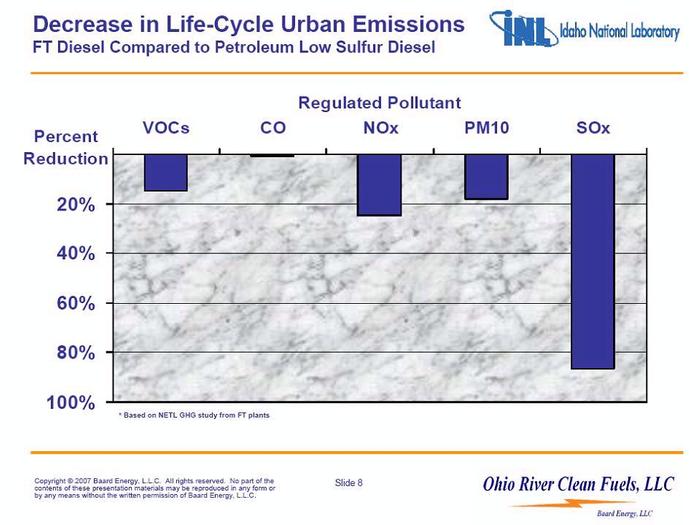
A new study released yesterday, May 9, 2007, conducted by the U.S. Department of Energy’s Idaho National Laboratory (INL), shows the environmental and public health advantages of coal-to liquids (CTL). The study looked at Baard Energy’s Ohio River Clean Fuels project currently under development in Wellsville, Ohio. Baard Energy’s project will produce ultra-clean liquid transportation fuels through the gasification and processing of domestic coal.
While CTL enjoys bi-partisan support in Congress for energy security reasons, the new study highlights additional reasons for supporting CTL – environmental and public health benefits. According to the study, CTL will reduce emissions of sulfur dioxide by more than 80 percent and cut nitrogen oxide emissions by more than 20 percent. In addition, INL found that Baard’s CTL fuel will reduce particulate matter emissions by nearly 20 percent, slash emissions of volatile organic compounds by close to 20 percent and also reduce emissions of carbon monoxide.
IN CASE YOU MISSED IT…INVESTOR’S BUSINESS DAILY CORRECTLY IDENTIFIES SOURCE OF HIGH GAS PRICES
IN CASE YOU MISSED IT… INVESTOR’S BUSINESS DAILY EDITORIAL: Supply And Demagogues Posted 5/9/2007 Charles Schumer wants to investigate gas prices. Look in the mirror, Chuck. The definition of insanity is doing the same thing over and over and expecting a different result. That’s the Democrats’ energy policy. Considering that nothing much has changed on […]